
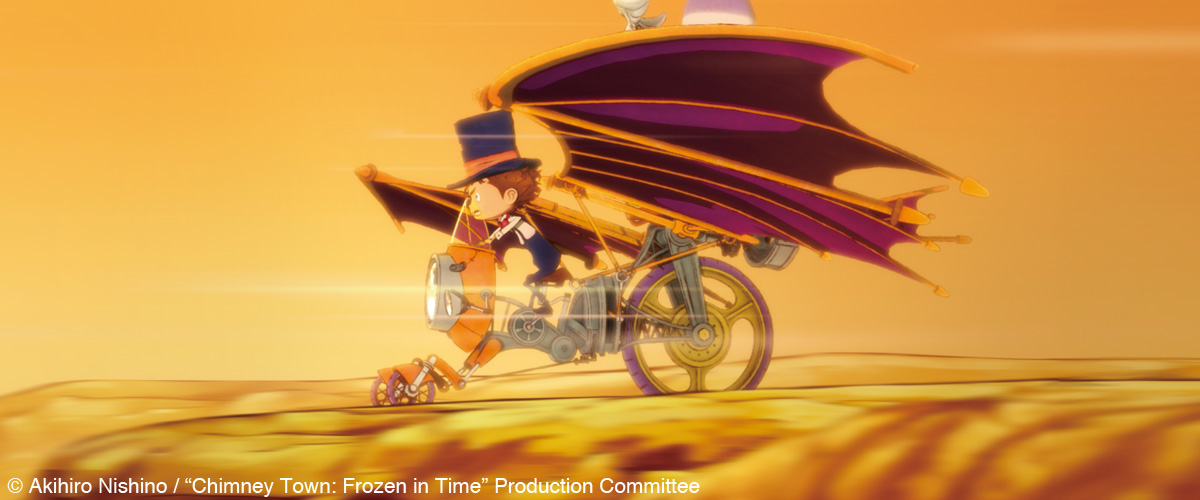
“Chimney Town: Frozen in Time”
Synopsis
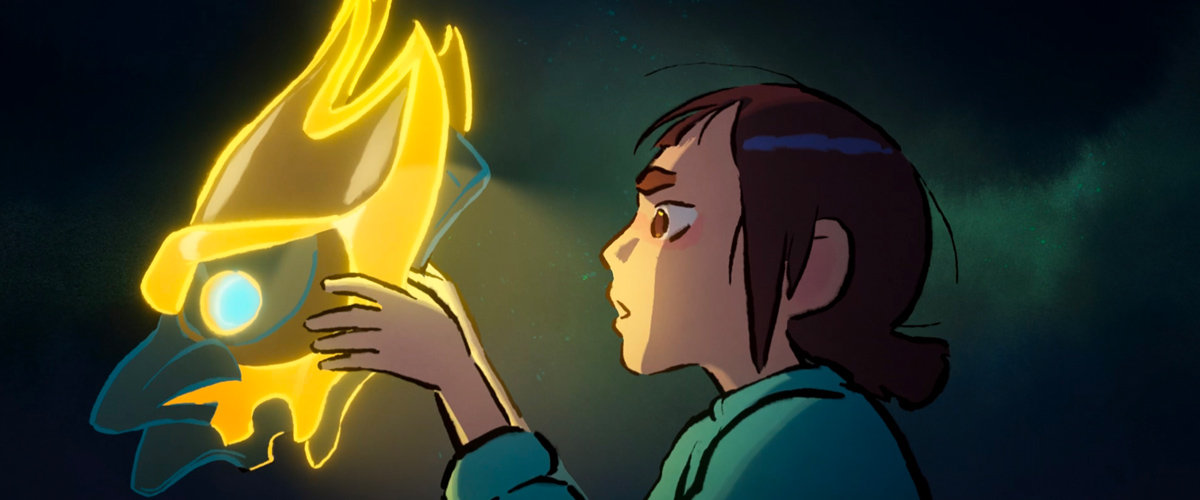
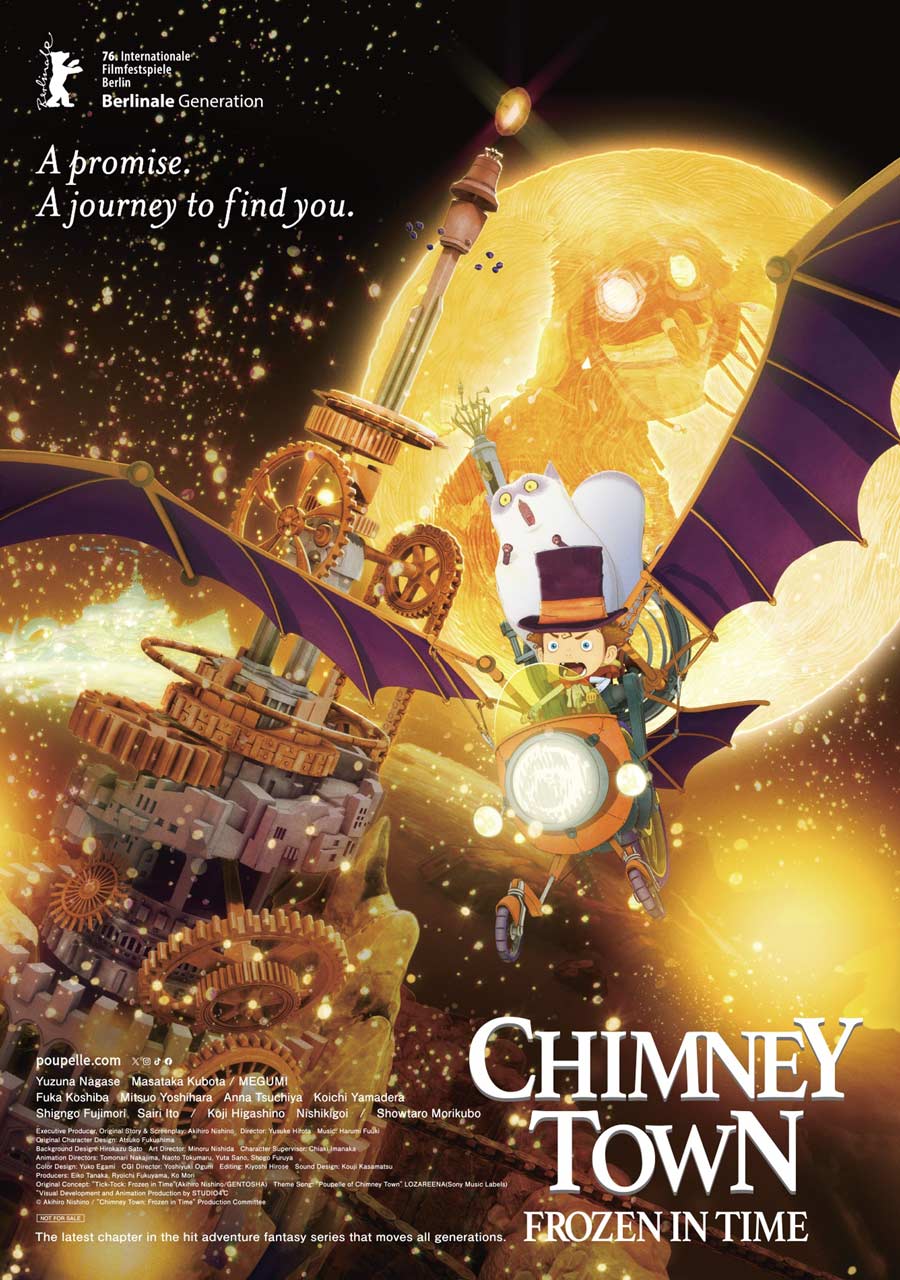
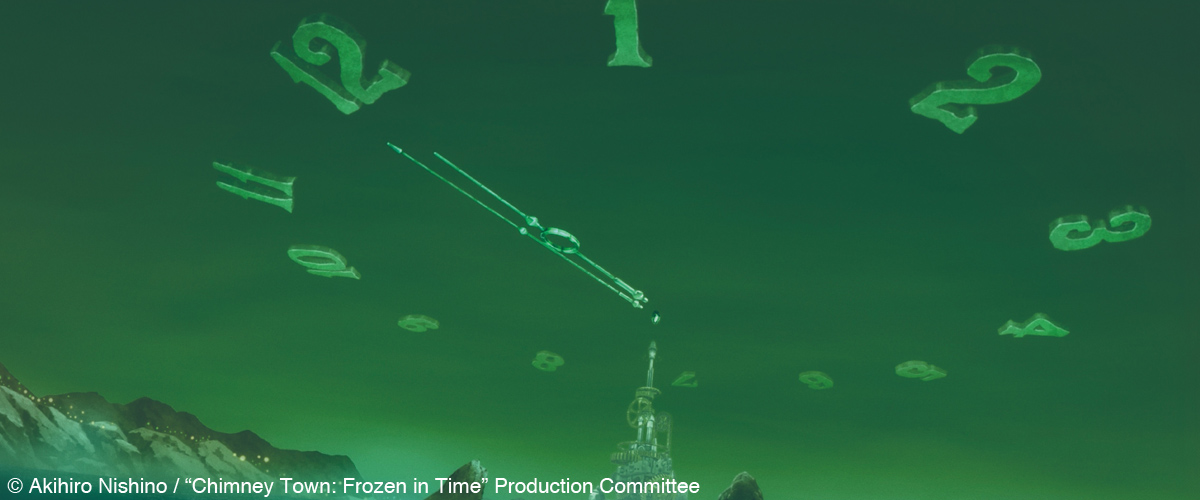
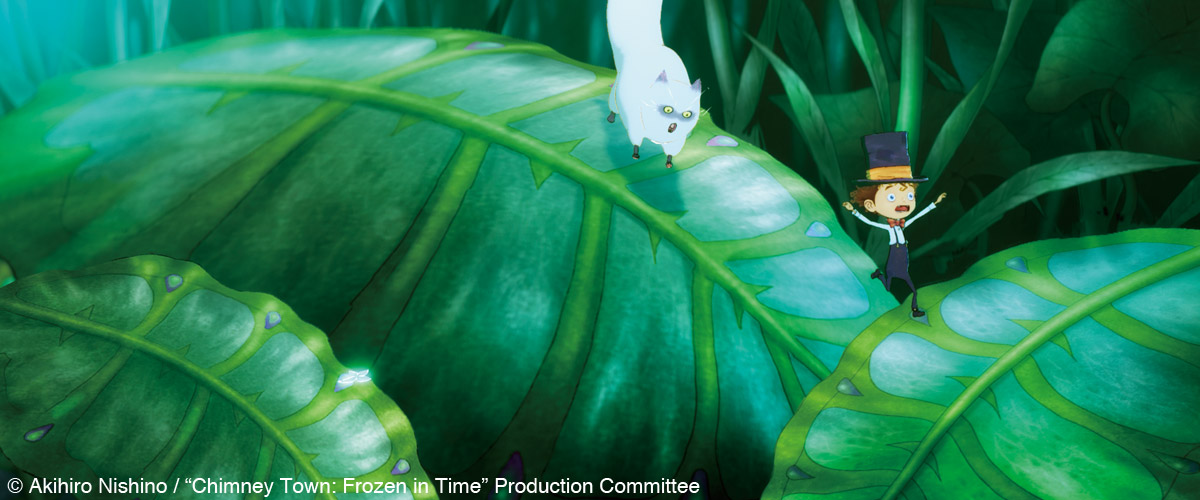
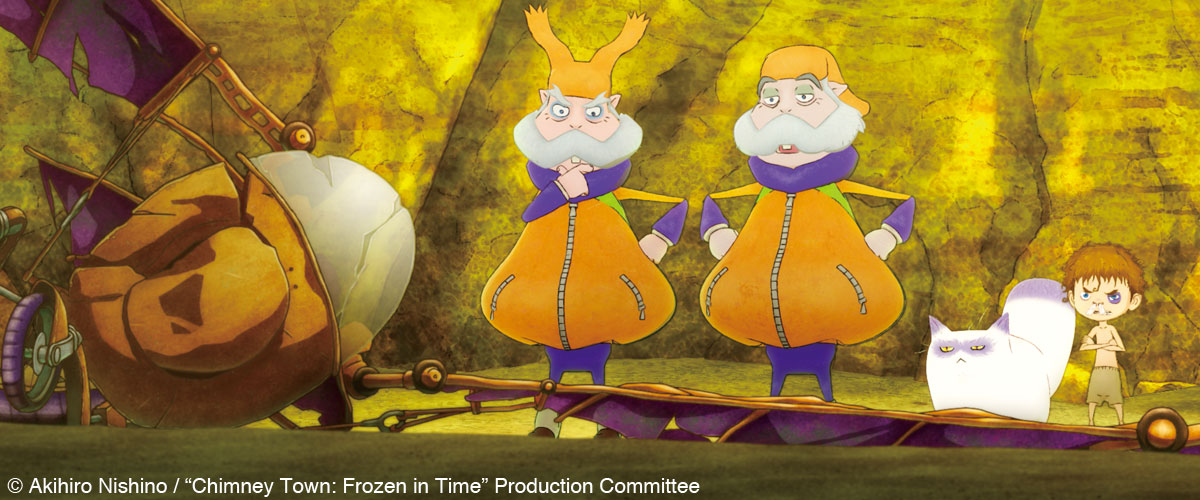
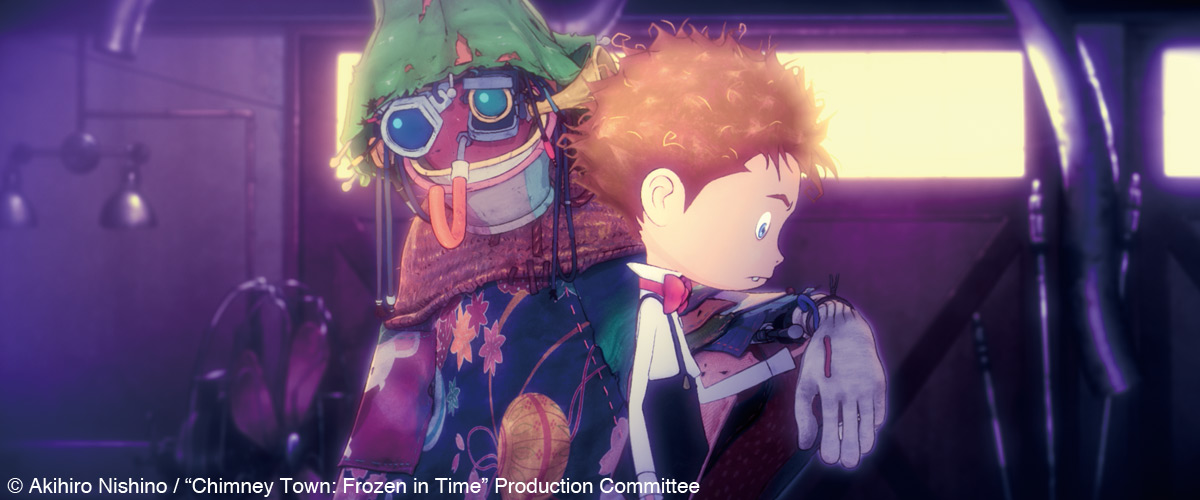
A young boy called Lubicchi is filled with sorrow after losing his best friend, Poupelle. Then he accidentally wanders into a mysterious realm that governs time. In this world, any clock that stops ticking is immediately discarded. But one strange tower remains standing despite its clock being frozen at 11:59. Lubicchi discovers that the only way to return to his own world is to restart this stopped clock. Together with his companion, Fluff, he begins to unravel the mystery of the clock tower. During his journey, he encounters Gus, a man who has kept the faith and waited for a hundred years, and Nagi, a tree spirit who once took human form. When Lubicchi finally regains the courage to believe, a miracle occurs on Halloween night.
Film credits
Directors: Yusuke Hirota
Scriptwriter: Akihiro Nishino
Music: Harumi Fuuki
Sound Design: Kouji Kasamatsu
Producers: Eiko Tanaka (Studio 4C, Japan) and Ryoichi Fukuyama (DENTSU, Japan)
Executive Producer: Akihiro Nishino (Chimney Town Inc., Japan)
Target audience: Family
Running time: 98’
Chimney Town: Frozen in Time is an awaited Japanese animated feature film that was nominated for the Generation section of the 76th Berlin International Film Festival and had its world premiere there. It is the sequel to Poupelle of Chimney Town (2020), which earned approximately 2.7 billion yen at the box office in Japan alone and received international acclaim, including a nomination for the Feature Film Competition at the Annecy International Animation Film Festival 2021.
Chimney Town: Frozen in Time will be screened at Annecy International Animation Film Festival 2026 in the official selection ‘Annecy Presents’.
We heard from the film’s producer, Eiko Tanaka, and the film’s director, Yusuke Hirota, about the story behind the creation of Chimney Town: Frozen in Time.
Interview with Eiko Tanaka
Hideki Nagaishi (HN): Could you please briefly let us know what kind of film projects the first film, Poupelle of Chimney Town (2020), and the second film, Chimney Town: Frozen in Time (2026), are?
Eiko Tanaka: The first film, Poupelle of Chimney Town (2020), is based on the picture book of the same title by Akihiro Nishino, one half of the comedy duo King Kong.
Nishino-san formed King Kong with Yuta Kajiwara, the other half of the duo, whose stage name is Kajisac, in 1999, and quickly became popular, hosting their own television programmes. Later, Kajisac-san went missing of his own accord, and Nishino-san temporarily suspended his activities as a comedian. I have heard that it was during that period that Nishino-san began drawing pictures with a ballpoint pen.
Nishino-san could have succeeded as a solo comedian, but he continued creating and publishing picture books while waiting for Kajisac-san to return, so that there would always be a place for him to come back to. Among those works, Poupelle of Chimney Town became a major hit, selling over 750,000 copies in Japan and continuing to sell to this day.
The animation adaptation of the picture book became the first film, Poupelle of Chimney Town, which was conceived as the story of Poupelle’s birth. The second film, Chimney Town: Frozen in Time, tells the story of Poupelle, the disappeared friend of the protagonist Lubicchi, returning. In that sense, it overlaps with the real-life story of King Kong itself.
The animation adaptation of the picture book became the first film, Poupelle of Chimney Town, which was conceived as the story of Poupelle’s birth. The second film, Chimney Town: Frozen in Time, tells the story of Poupelle, the protagonist Lubicchi’s friend, who disappeared, returning. In that sense, it overlaps with the real-life story of King Kong itself.
HN: Had you already read the original picture book before meeting Nishino-san?
Eiko Tanaka: At the time, I did not watch children’s television programmes in the early evening, so I knew nothing about King Kong’s exploits and had not read the original picture book.
The picture book Poupelle of Chimney Town features highly detailed and rich visuals, and the character of the “rubbish human”, born from rubbish, is new and truly captivating.
As the book itself is short, we build the story universe by expanding the content with many ideas we came up with, in order to make the film’s story substantial enough for a feature-length film.
For example, we experimented with various ideas, such as the scene where Poupelle is generated in the rubbish dump, the scene where dancing suddenly breaks out in the town, the scene of a narrow escape in the incinerator, the scene with the mine cart, and the town’s rubbish collection methods. By incorporating these devices, we present the process by which the protagonist, Rubich, and the rubbish human Poupelle meet and deepen their bond in a way that would captivate the audience. It was a very enjoyable process.
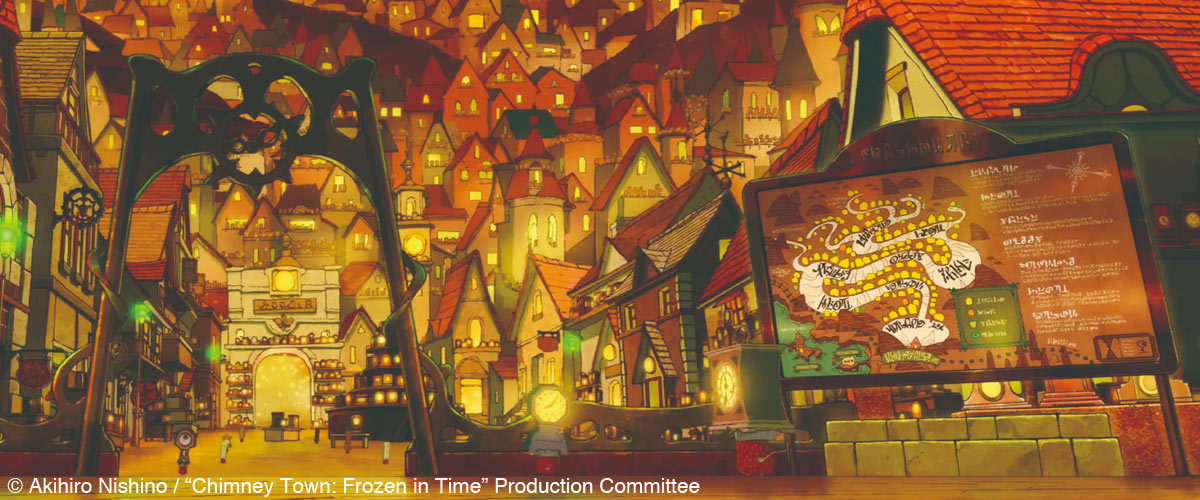
In developing the film’s story universe, we also built the town’s setting based on realistic reasoning, such as imagining that all the trees would have been cut down and burned because it is a chimney town, and that coal mines would extend endlessly in all directions, both vertically and horizontally.
HN: Could you please let us know about the background of the production of the latest film, Chimney Town: Frozen in Time?
Eiko Tanaka: The first film, Poupelle of Chimney Town, resonated deeply with many people through its powerful message that “if you believe wholeheartedly, the dream will come true”, grossing approximately 2.7 billion yen in Japan alone. It was an unprecedented hit for an animated film based on a picture book.
As Poupelle disappears at the end of the first film, the sequel has to be “the story of Poupelle’s return”. So, drawing on Nishino-san’s own experience of “the courage to wait” whilst his comedy duo partner, Kajisaku-san, was missing, the story direction of Chimney Town: Frozen in Time was finalised by making its theme the story of the “11 o’clock hour”, a personal theme for Nishino-san: “After the 11 o’clock hour, when the hands do not meet, the hour and minute hands will inevitably cross, symbolising the power to believe in the future.”
HN: Could you please let us know the highlights of Chimney Town: Frozen in Time?
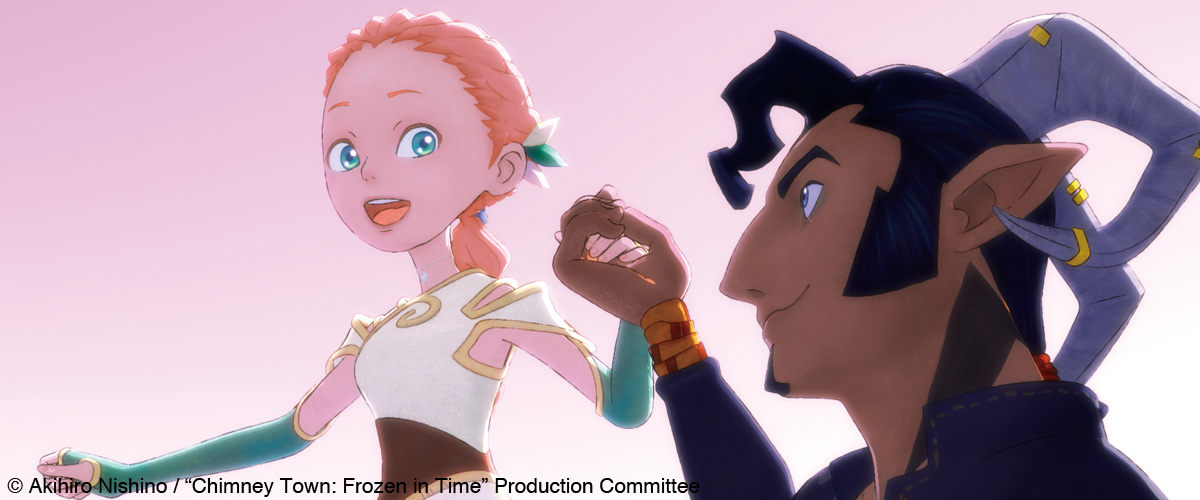
Eiko Tanaka: Firstly, the charming characters. A huge part of this is the talent of Atsuko Fukushima, who was responsible for the film’s character designs. Building on the visuals from the original work, the main characters have been brought to life as endearing, cheerful figures with a rich range of expressions. In Chimney Town: Frozen in Time, you can meet more characters than in the first film, including people from another world and monstrous creatures.
As the story is set one year after the first film, Hirokazu Sato has designed and developed both Chimney Town—now free of smoke and bathed in sunlight—and the other world. Art director Minoru Nishida then depicted the two distinctly and clearly through the colours and the atmosphere. I hope that you will find it enjoyable as a work of art as well.
Above all, the central theme of the film ‘the power to trust and wait for others’ will surely warm everyone’s hearts. And you will find yourself rooting for Lubicchi’s inquisitive spirit ‘you won’t know until you try.’ I believe that meeting Rubich, with his honest, pure and single-minded nature, enrich your heart.
Interview with Yusuke Hirota
Hideki Nagaishi (HN): Could you please briefly let us know the film’s story of the first film, Poupelle of Chimney Town?
Yusuke Hirota: The story is an adventure about a young boy named Lubicchi, who continues to believe in his father’s words, “there are stars beyond the smoke,” in Chimney Town, where the sky cannot be seen because it is covered in smoke.
On Halloween night, he encounters Poupelle, who is born from rubbish, and together they set out on a journey to see the stars.
HN: Please tell us about the theme of the second film, Chimney Town: Frozen in Time, which had its world premiere at the Berlin International Film Festival 2026.
Yusuke Hirota: The theme of the film is “the power to trust and wait for others.” To wait for another person is also to believe wholeheartedly in that person, and the story depicts the strength, kindness, and sincerity that exist within that act.
HN: Could you tell us how you joined the first film and this sequel as the director?
Yusuke Hirota: The beginning of the first film project was around ten years ago. At the time, I had continued to share my thought that I wanted to direct a film with Tanaka, the producer, whilst working as a CGI director at STUDIO4℃ for around 15 years.
The reason was my desire to express what I feel and think through my work and for others to enjoy it. I have also been feeling that creating animation has the power to make the future a slightly better place through my involvement in anime production for many years.
One day, producer Tanaka told me about the first film project with Nishino-san’s picture book Poupelle of Chimney Town in her hands.
In fact, ever since I first came across the book in a bookstore, I had felt that its detailed and profound illustrations looked like scenes from a film and that it was a work well suited for adaptation. Around that time, my own child had just been born, and it gave me a strong desire to work on a story about parents and children.
Hence, without hesitation, I quickly accepted the offer, and it became my debut as a director of a feature-length film.
HN: Could you tell us how you came to direct the sequel, Chimney Town: Frozen in Time?
Yusuke Hirota: Since the first film was completed, Nishino-san has shown his desire to make a sequel. While the project is very dear to me, I also felt a great deal of pressure about directing the sequel because the first film had been such a hit in Japan.
Before long, Nishino-san formally approached STUDIO4°C about the next film project, and about a year after the release of the first film, producer Tanaka once again offered me the opportunity to join the project as the director. As I felt a strong sense of trust from Nishino-san, I chose to take on the sequel as well.
HN: Having directed two films, realising your long-held dream, how has the experience been?
Yusuke Hirota: First of all, the fact that so many people watched the first film and I could hear how moved they were was a great source of encouragement for my future career as a director.
At the same time, I came to understand deeply that the role of director is not as flexible as I had previously imagined it to be. It involves continually striving to make the best possible choices within various constraints, such as schedule and budget, and I was able to truly grasp the weight of that responsibility.
It is important to accept the aspects I cannot control myself and find a point of resolution that I can be satisfied with.
So, I spoke directly with the heads of each department to gain a clear understanding of the situation, consulted closely with the line producer, and, whilst leaving the final decision to Producer Tanaka, concentrated on making a series of the best possible choices step by step.
HN: Could you please let us know about the world-building and visual design for the film, Chimney Town: Frozen in Time?
Yusuke Hirota: From the very early stages of planning, we invited Atsuko Fukushima, who created the original character designs, and Koichi Sato, who was responsible for the art direction, to join the screenplay discussions.
We built the world of the film while allowing the screenplay, character design, and art setting to influence one another, developing them simultaneously.
One of the main settings of the film’s story, the “Millennium Fortress”, is a place that feels just like Lubicchi’s inner world.
For that reason, I decided to depict it as a space where the unknown for Lubicchi and his imagination intermingle, making extensive use of organic and mysterious forms.
Furthermore, to give the audience the sense that they are journeying alongside Lubicchi through this world, I made a conscious effort to structure the narrative flow so that they encounter unfamiliar cultures and landscapes at every turn.
HN: Could you please let us know about the creation of the music for the film?
Yusuke Hirota: I wanted to prioritise straightforward entertainment value and a Halloween-like atmosphere whilst retaining the distinctive ‘Pupel’ style established in the previous film.
So, I was looking for a composer who could express both grandeur and humour. Then the producer suggested Harumi Fuuki, and I felt she was the perfect choice, as she has composed numerous melodies with a cheerful quality that appeals to both children and adults.
Like the music she creates, she herself is a very cheerful and flexible person, so we were able to share our vision smoothly, and she coordinated the finest music throughout the entire film.
HN: Could you please tell us about the highlights of Chimney Town: Frozen in Time?
Yusuke Hirota: With a diverse cast of characters appearing one after another, visuals of various locations across the many worlds where the story unfolds, exciting scenes and comical scenes, the music, and a narrative centred on the theme of ‘the power to trust and wait for others’, we have created a film brimming with charm that will appeal to a wide audience, from children to adults.
I hope you will enjoy it on the big screen with the cinema’s immersive sound. This is the second instalment, but we made it so that you can enjoy it even if you have not seen the first film. On the other hand, having seen the first film will allow you to appreciate this one even more deeply. So, I would be delighted if you could watch both.