
Emma Makes Waves
Synopsis
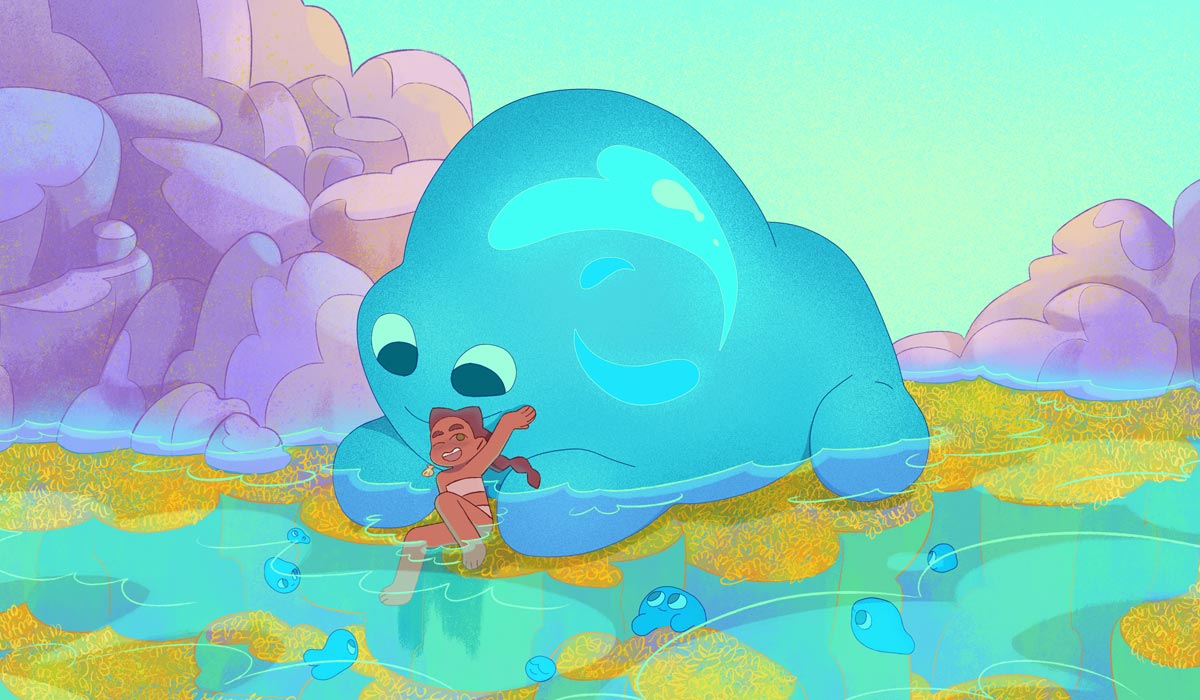
Nine-year-old Emma spends her first summer without her parents on the volcanic island where her grandparents and cousins live, discovering a newfound sense of freedom. The beautiful island is also home to the Pantùs, impressive aquatic guardians who watch over its people – and they are determined to look after Emma too! Between new experiences, a different way of life and fantastical guardians she didn’t ask for, Emma’s summer turns out anything but ordinary!
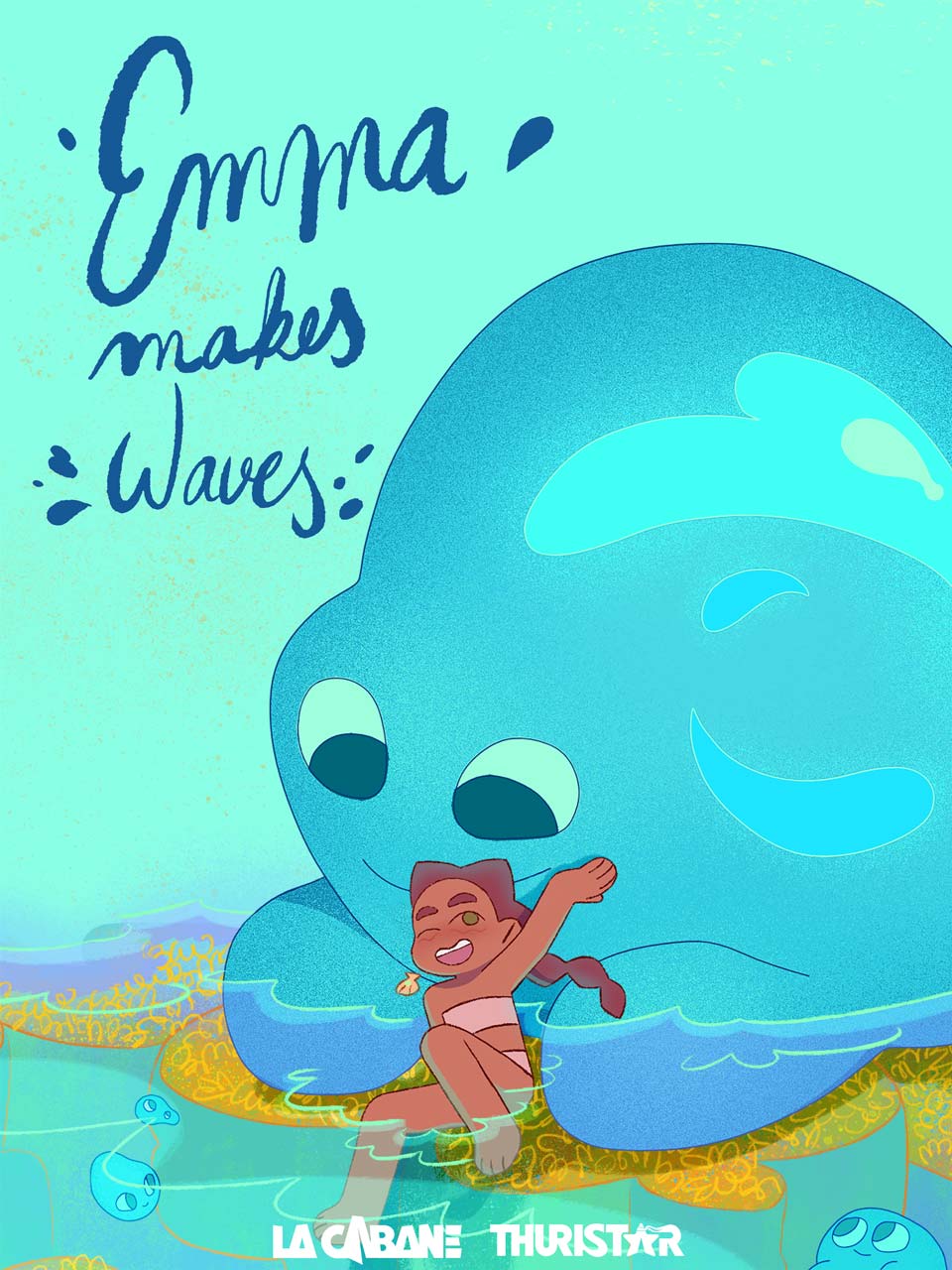
Director: Camille Chao
Authors: Giulia Iacopini and Julien Gallet
Graphic Authors: Giulia Iacopini and Camille Chao
Producers: Perrine Gauthier (La Cabane Productions, France) and Joeri Christiaen (Thuristar, Belgium)
Format: 52 X 11’
Target audience: Children 6-8
Techniques: 2D digital
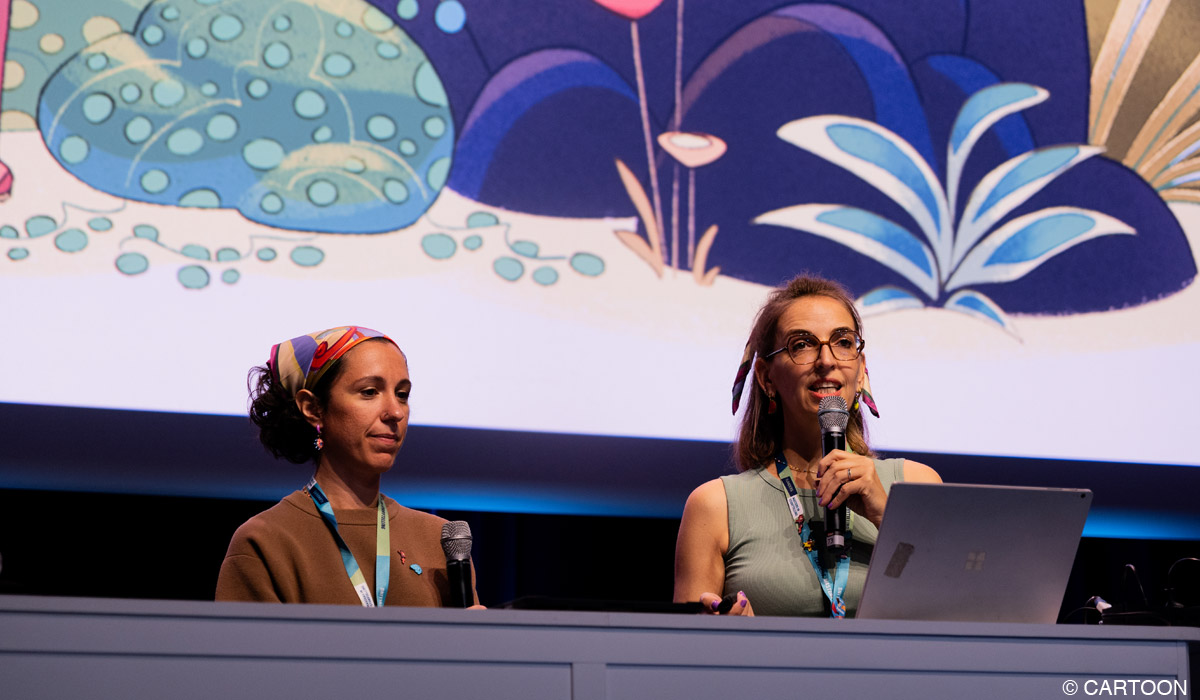
La Cabane Productions, France, and Thuristar, Belgium, who are famous for the globally successful animated series Mush-Mush and the Mushables and the multi-awarded animated short Luce and the Rock, returned to Cartoon Forum 2026 with their fascinating new children’s animated series project, Emma Makes Waves, targeting children aged around 6-8.
Emma Makes Waves is a growing-up story about a 9-year-old girl, striking for its colorful and charming visual appeal. It depicts the story of Emma’s precious childhood with the Pantùs, the aquatic guardians, in a beautiful story universe inspired by Pantelleria Island in Sicily, Italy.
We could hear the insightful story behind the project from Camille Chao, the director and co-graphic author of the series; Giulia Iacopini, the co-author and co-graphic author of the series; Julien Gallet, the co-author of the series; and Perrine Gauthier, the producer of the series.
Interview with Camille Chao, Giulia Iacopini and Julien Gallet, and Perrine Gauthier
Hideki Nagaishi (HN): Camille, as the director of the series, what aspects of this animation series are you emphasising to capture the interest of the target audience?
Camille Chao: At its heart, the series is about a girl spending her first holiday away from her parents. It’s a story about those first meaningful memories of growing up. I think it’s a subject that can speak to a lot of kids, while also being particularly exciting for children, who are often eager to become “grown-ups” themselves. But I also like the idea of reminding them that growing up doesn’t have to mean rushing through childhood.
There is something precious about taking your time, discovering the world at your own pace, and simply enjoying being a child within it. I hope the series can encourage audiences to really savour those moments, because they only happen once.
I also love the way the series portrays family and friendship, and especially the importance of helping and looking after one another. There’s something very comforting to me about exploring relationships between characters that are built on kindness, trust, and mutual support.
When directing the series, I want to stay focused on the characters’ emotions, and to frame the story in a way that allows us to experience things through Emma’s eyes.
HN: Giulia, as a co-author of the series, what messages or experiences would you like to deliver to the audience through this animation series, and why?
Giulia Iacopini: I would love to convey the wonder of summertime through the eyes of Emma. I feel privileged that I was able to spend my summers on a beautiful Sicilian island, and year after year I became more aware of how special a place it is compared to the busy Rome where I’m from. I also remember how grown-up I felt the first summer my parents let me go by myself to invite my friends over! Or how cool it was that I was allowed to go walking around the harbour with my friends, because they would close all the streets at night to let people walk around and play music on the road…
I’m not fully grown up yet, but that childhood already feels so far away, especially now that everything is so dependent on technology, social media, and smartphones. I hope to make kids discover the joy and wonders of simple things like ordering an ice cream all by yourself, finding the treasures that are hidden under the rocks on the shore, and helping decide the menu for the family dinner. I want to show them a slower, simpler life that you can experience even if you don’t live on an island protected by wonderful big blue creatures!
HN: Julien, how do you and Giulia Iacopini work together on the writing of the project?
Julien Gallet: We work very collaboratively, constantly exchanging ideas based on our childhood memories and her experiences in Pantelleria. Sharing different cultural backgrounds and dramaturgical knowledge has helped us bring a specific yet universal perspective and tone to the project. I also really enjoyed developing the show with both the English and French languages in mind, and thinking about how to make some fun ideas pop in both languages!
HN: Julien, what are you paying the most attention to during the development of the story? And what kinds of creative challenges have you faced so far regarding the story’s development?
Julien Gallet: I’m paying particular attention to making the characters emotionally compelling and relatable, while keeping the story’s beats and surprises strong. The main creative challenge has been finding the right ways to embody Emma’s journey towards independence, while making sure the stories and adventures remain amusing, adorable, and happily summery!
HN: Within the visual design of this project, what elements do you currently find most appealing, and what do you consider to be its most distinctive and attractive characteristics? What aspects of the visual design, the characters, and the story world are you focusing on or prioritising the most?
Camille Chao: I really wanted to immerse myself in Giulia’s graphic universe, which is very vibrant and colourful. The environments she creates are incredibly lively, so my role has been more focused on the characters: their attitudes, their shapes, and the way emotions can be expressed through design and movement.
Finding ways to connect my own graphic approach with Giulia’s world has been a really interesting part of the collaboration. I think bringing our two different perspectives together can create something that feels both sunny and distinctive. We wanted to achieve a visual style that creates a nice dialogue between the soft, rounded style of Giulia’s backgrounds and the colours that make them so bright, and the simplicity and roundness of the character designs, which are brought to life through dynamic expressions. There’s something I really like about that contrast: the characters are simple, but their expressions are full of energy, echoing the lively world around them.
This collaboration has been a very enriching process. I feel like I’m discovering and exploring this island alongside Giulia, and that’s probably one of the things I enjoy most about working on the project.
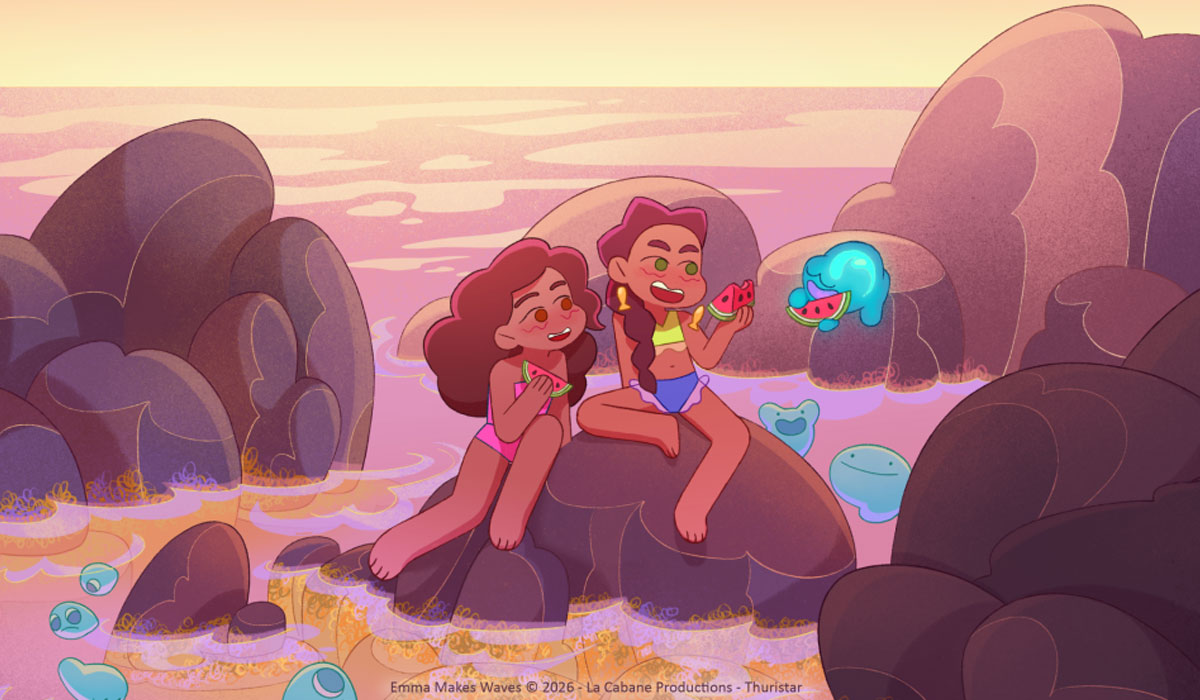
HN: Giulia, how do you and Camille Chao work together on the visual design of the project? Looking at the project so far, are there any elements or achievements that you feel were made possible specifically through this collaboration?
Giulia Iacopini: I can confidently say that what the project has become was only possible because I had the honour of working with Camille! It was a bit of a search at first because we had to get to know each other as artists, and I’m so happy with the result. Camille gave life to Emma, Nicà, and all the other characters. I share initial inspirations with her, drawn from my experience, and she was able to add her own twist to them.
As for me, I took care of building the environments, and working with Camille has forced me (in a good way!) to adapt my style to her characters: as a background artist and illustrator, I tend to create environments that are full of details, textures, and colours. I needed to make the backgrounds support and highlight the characters, not make them disappear into them. So I simplified and stylized the style even more, and I love how our styles have merged together to create something new and unique.
HN: How did this project begin, and what led you to decide to make it your studio’s new project?
Perrine Gauthier: It’s a little embarrassing to admit, but the origin story of Emma Makes Waves starts with me scrolling on LinkedIn (haha).
In between advice on how to boost my career, AI slop, and lots of rocketship emojis, I came across an illustration by an Italian artist named Giulia Iacopini and absolutely loved it. I loved the colors, the shapes, the atmosphere, and it felt like a glimpse into a bigger world that I really wanted to dive into.
So, I reached out to Giulia and proposed developing an animation series together!
HN: Why and how did the three core creators of the project, Camille Chao, Giulia Iacopini, and Julien Gallet, become involved?
Perrine Gauthier: Giulia already had a lot of experience working as a background artist on animation series and films, but she had never developed a project as an author. So, I offered to partner her up with two other talented people: Julien Gallet as co-writer, and Camille Chao as graphic co-author and director. Although I had never worked with Julien before, I knew of his work and immediately thought about him for Emma Makes Waves because I felt he could bring his experience as well as his sensibility and humor to the project. As for Camille, I reached out to her after seeing some of her outstanding storyboard, staging, and animation work on other projects. Her character skills, amongst other things, are a very complementary match with Giulia’s background design and colour expertise.
HN: Lastly, Perrine, as the producer of the series, what do you think are the key aspects of this animation series that will appeal to its target audience?
Perrine Gauthier: Emma Makes Waves talks about the first steps toward independence, at a child’s level. At Emma’s level! It’s her first time going away without her parents, and therefore a very special summer for her.
Emma is at an age where she’s old enough to want real autonomy, and at the same time young enough to need real support. An age when kids want to actively experiment with their independence, while feeling safe. I think this feeling, as well as the quality summertime she spends with her grandparents, cousins, and the extraordinary Pantus, are both relatable and aspirational for a 6 to 8-year-old audience.