
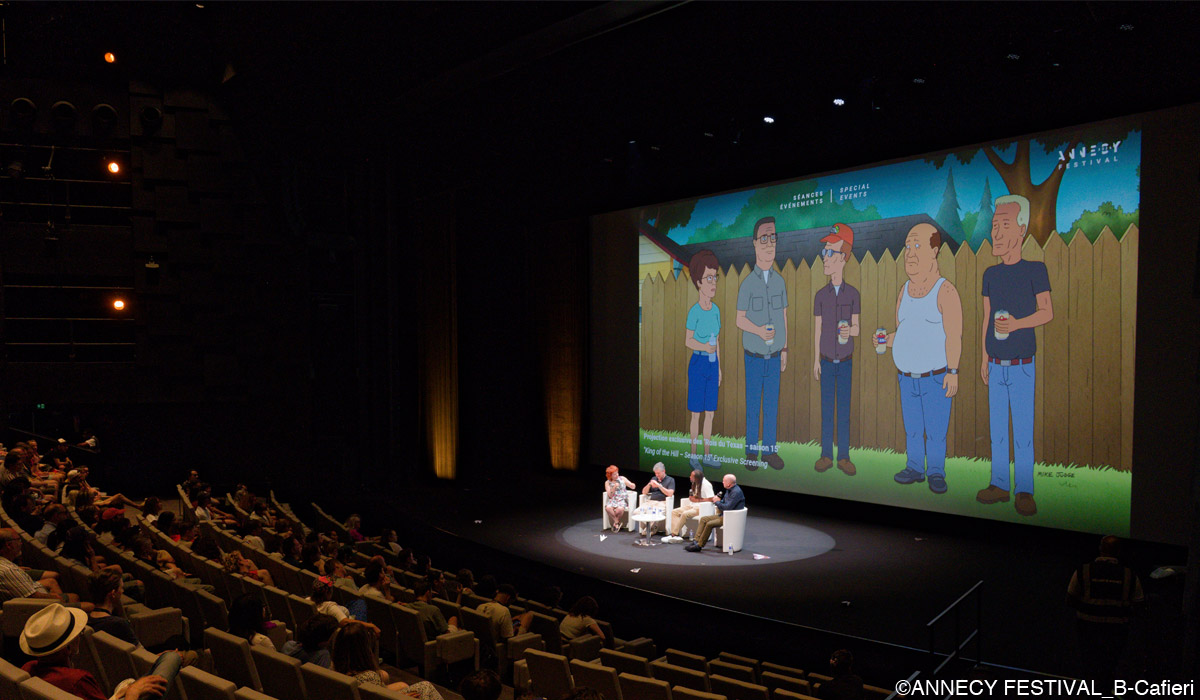
Mike Judge and Greg Daniels, creators of the Emmy‑winning animated sitcom series King of the Hill, and Saladin K. Patterson, the showrunner since Season 14, have attended the Annecy International Animation Film Festival 2026. Judge received the Honorary Cristal Award at the festival for his decades-long career and major impact on adult animation.
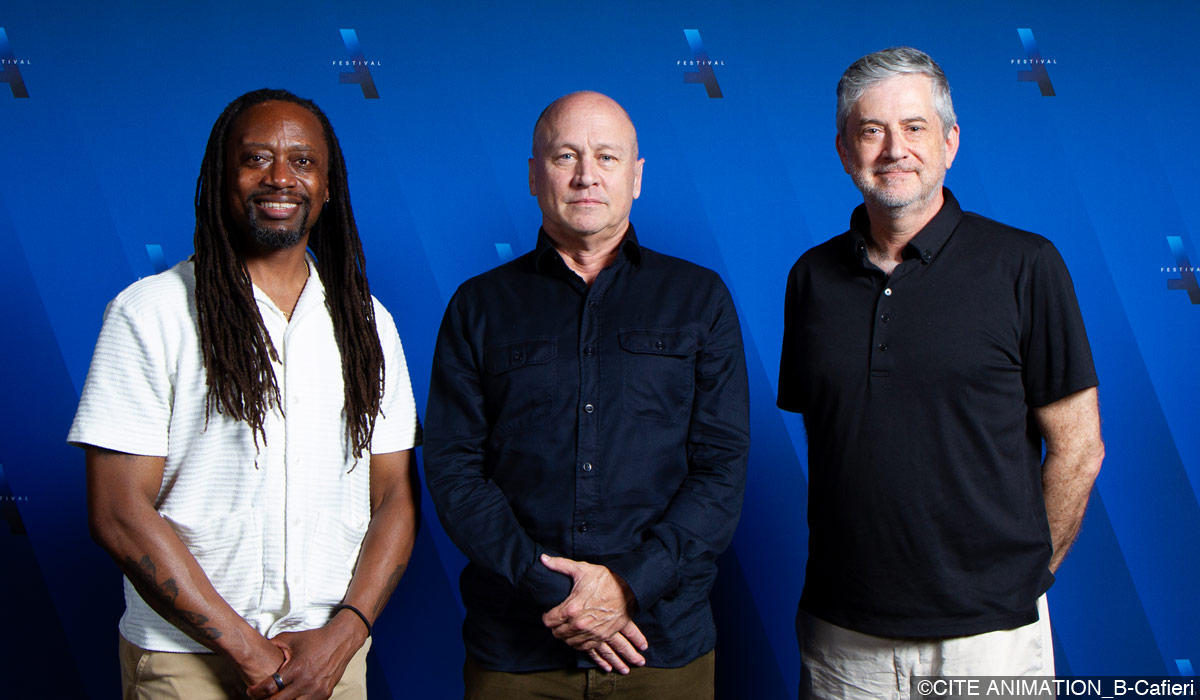
Saladin K. Patterson: Showrunner and executive producer
Mike Judge: Co-creator and executive producer
Greg Daniels: Co-creator and executive producer
While remaining one of the most iconic American animated sitcoms, King of the Hill is celebrated for its grounded, observational style and its ability to find narrative material within the ordinary. Having debuted in 1997, The series has long stood as a definitive portrait of the American landscape, capturing the nuances of suburban life with a unique blend of sincerity and dry humor.
Following the conclusion of the original run with Season 13 in 2010, the beloved series returned with Season 14 in 2023. We’d like to share a short report of a special screening and talk session for Season 15, followed by a special interview.
A short report of a special screening
Here are some of the comments that particularly stood out during the session, listed in chronological order:
• Regarding how the show has served as a “portrait of America” over the years, Judge noted that a key theme is the aging of the characters. He pointed out that he eventually became older than Hank Hill, and the show now reflects the life experiences of the showrunners themselves.
• The creators also discussed Bobby Hill, noting that fans have been eager to see him grow up. His development was influenced by the work ethic he inherited from Hank. Greg Daniels recalled that Bobby was originally inspired by a kid he saw in Circuit City.
• Regarding the artistic creation of the series, they noted that Brad Bird served as a consultant on the initial storyboarding. Saladin K. Patterson highlighted how the show’s humor is heavily carried by its music, while Greg Daniels expressed a particular love for foley work.
• Finally, they discussed the changes required as the industry transitions from the early days of television to the current situation. Judge clarified that his approach is not strictly market-driven, as he believes it is not “their job” to chase every trend, even if the market turns out to be wider than originally anticipated.
Following the public presentation, the conversation continued with our interview that delves deeper into the show’s creative DNA.
Interview with Mike Judge, Greg Daniels, and Saladin K. Patterson
Trayton Scott (TS): Now that the first two seasons of the King of the Hill revival, seasons 14 and 15, are completed, in terms of the settings and characters, how are you adapting a show that originated in the ’90s into the modern era?
Greg Daniels: When we started the show, we had a catchphrase: “Andy Griffith’s back and he’s pissed!”
The idea was that The Andy Griffith Show was a TV show that presented a very idealized version of small-town America, and Andy Griffith was this very genial voice of reason; a reasonable character. There had been so many years of shows where a man like Hank Hill would only be portrayed as a fool, so we decided to flip it on its head, be more realistic, and make him and his friends the heroes. Now, when you bring a ’90s show’ back today, it’s as if Hank, whose voice is from a different era, can come back and give commentary on how crazy life is today.
Mike Judge: When we hit on the idea of the Hills having been away in Saudi Arabia for so many years, it seemed like a good way in. When we started writing the show, I was thinking about the last 15 years, give or take five, and how much things have changed. It seems like a fun way in because the original run was always about the annoying things in our modern life, and there are so many new annoying things in our modern life to put them into. It seems like a good time to come back.
Saladin K Patterson: The audience from the original show trusts Hank and his opinions, trusts that he’s the one who is going to be fair. So, Hank is allowed to ask some questions about modern-day things that, if other people joked about, would get cancelled for. Since people trust Hank, like Hank, and know Hank’s heart is always right, he’s able to question, “Why does it have to be like this?” and “Is this the most sensible way to do it?” The audience will still allow themselves to think, “Oh, I guess he has a point there,” whereas another character in another show probably wouldn’t be able to get away with that.
TS: There are a lot of exciting developments in season 15. How does the modern environment of the show influence the overall future arc or trajectory of King of the Hill, and how does that change your approach to writing for the future of the series?
Saladin K Patterson: We have our Bobby and Connie characters who are aged up now, and they’re experiencing things that kids in their 20s these days experience. Connie is taking the traditional college route, while Bobby is taking the more courageous route of going out on his own. That’s reflected in real life; we’re tracking them in terms of what real people that age deal with.
It’s the same with Hank and Peggy, we’re tracking what they deal with as part of their lives, too. But, as Mike was saying earlier, it’s less about us trying to appeal to what’s going on in the world or what the audience wants. It’s honestly about focusing on what our characters would really be experiencing: what they would do, and what they would have to choose between. That’s where the comedy comes from. We’re focusing more on that so that we’re naturally going where our characters would go today.
Mike Judge: It always comes back to the characters first.
Greg Daniels: It just occurred to me that when we started, there were a lot of shows about families, and I can’t really think of a realistic show, like a Roseanne-style show, about a family in the last 10 years. Maybe there are. But what this allows is for you to write about things happening to 20-year-olds, and also things happening to 50-year-olds, allowing the 50-year-olds to comment on and help out the people they love who are going through things. It’s a good genre for exploring real people.
TS: Saladin, as the showrunner of the new series, what was it like to work on the revival? How do you capture the heart of the original run and breathe new life into it?
Saladin K Patterson: When we started season 14, I leaned heavily on Mike and Greg for learning. I’ve described it as learning the rules of the universe of Arlen in King of the Hill, but it’s really learning how they approach storytelling, and how they approach putting themselves in the roles of our characters to understand what they would respond to, and what they wouldn’t respond to, to find stories to tell. Once I got a hold of that, I was able to say, “Okay, so let’s look at all those great stories that the original show did; what is a way that we can tell those sorts of stories with the new experiences the characters are going through?”
So that certainly had a learning curve, and Greg and Mike were very patient. But once it clicks, it clicks, and then you’re able to say, “Okay, this is who they are now.” It’s like having a personality test for every character we have now, so we can put them into situations to see how they could be stressed, or comedically pushed one way or another.
TS: What were the greatest challenges in the current season?
Saladin K Patterson: I would say there was a lot of momentum in season 14 from the changes in their lives: Hank and Peggy coming back from Saudi Arabia and reintegrating, Bobby pursuing a life as a chef, and him re-meeting the girlfriend he had when he was 12. The challenge now is that those things are like booster rockets that have fallen off, and now you’ve got to get to the moon under the power of individual storytelling.
It’s weird because you say “settling in,” although the seasons are just 10 episodes long now, whereas I would have had a vision of 10 seasons at 20 episodes each. Two seasons is really like one of the original run, right? But yeah, it can’t just be about what new technology Hank isn’t aware of because he’s been gone for nine years; it has to be stories that come from the real character conflicts, internal and external, that these guys are going to face in their everyday lives. Those are the normal challenges you have on any show.