

“Danse Macabre”
Synopsis
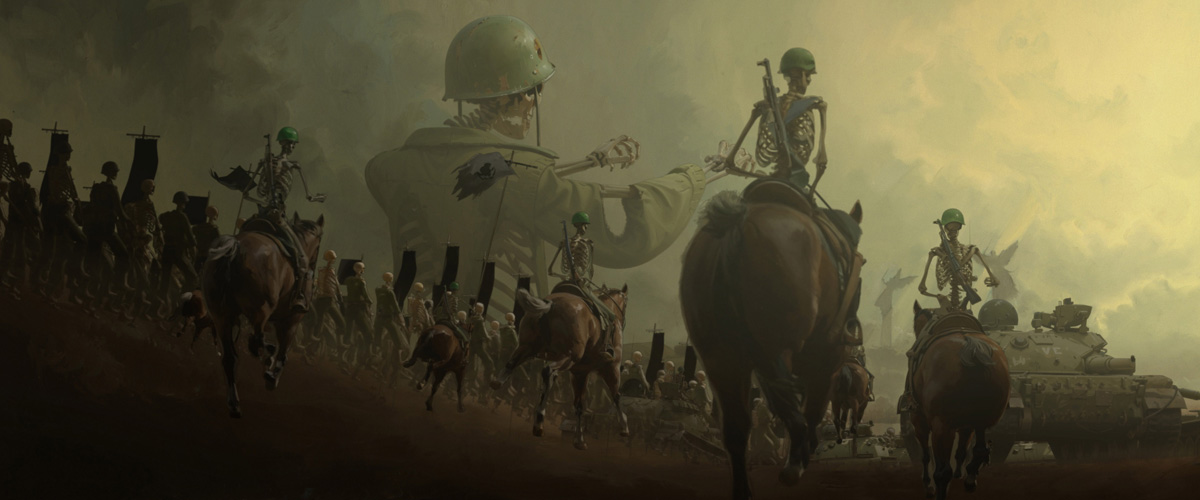
Resurrected by sinister muses, an army emerges from the darkness sounding the trumpets of war. In this apocalyptic nightmare, Shostakovich’s music drags us into a violent maelstrom of terror, destruction and human suffering.
Film credits
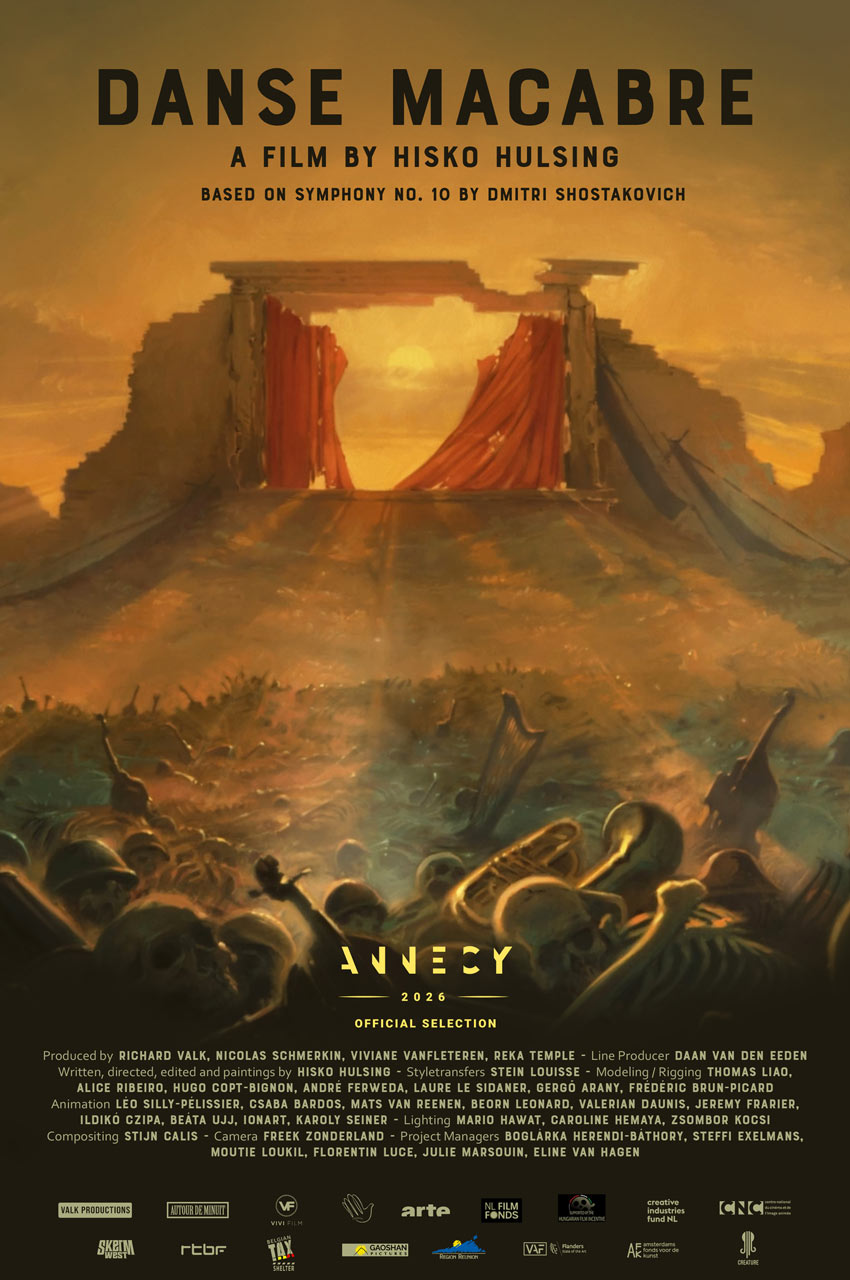
Director: Hisko Hulsing
Main Producer: Richard Valk (Valk Productions, Netherlands)
Co-Producers: Nicolas Schmerkin (Autour De Minuit, France), Viviane Vanfleteren (Vivi Film, Belgium), Réka Temple (Cinemon Entertainment, Hungary)
Composer: Dmitri Shostakovich (Symphony No. 10 in E minor op.93 – 2. Allegro)
Script, Storyboard, Editing: Hisko Hulsing
Compositing: Stijn Calis
Target audience: Young adults, Adults
Running Time: 5 min
Danse Macabre marks Hisko Hulsing’s long-awaited return to independent filmmaking since his multi-award-winning Junkyard (2012), following international recognition for his work on major productions such as Undone (2019) and The Sandman – A Dream of a Thousand Cats (2022).
The project was developed as a large-scale international co-production in the form of an animated short film, with a budget of approximately 470.000 Euro’s. It involves four established studios: Valk Productions (the Netherlands), Autour De Minuit (France), Vivi Film (Belgium), and Cinemon Entertainment (Hungary).
Set to Shostakovich’s Symphony No. 10 in E minor, Op. 93: II. Allegro, the film presents, in a dynamic, grand, and ominous manner, an apocalyptic vision of karma from which humanity has been unable to escape, spanning from ancient times to the present day. This vision is expressed through the artistic motif known as the Danse Macabre.
The film will have its world premiere at the Annecy International Animation Film Festival 2026, where it has been selected for the official competition. In addition, Hisko’s seven large oil paintings for Danse Macabre will be exhibited in a special retrospective of Autour de Minuit’s films, celebrating the company’s 25th anniversary. The exhibition will take place at Galerie Art By Friends (14 avenue du Rhône, 74000 Annecy) during the festival.
We were very pleased to have the opportunity to speak with the director, Hisko Hulsing, about the creation of this remarkable animated work.
Interview with Hisko Hulsing
Hideki Nagaishi (HN): What do you most wish to convey or share with the audience through this film? And do you have any particular aspects of the film in your mind that you would like audience to pay attention to when watching the film?
Hisko Hulsing: Wars have never really disappeared from the world’s stage. There is always some place on earth where countries, tribes, and religions fight each other. When I started working on this film 11 years ago, Russia took Crimea from Ukraine, and everybody seemed quiet about it. It was quite shocking. I started following what was happening in Russia, and it seemed to me that a resurrection of a form of fascism was taking place. That’s why my film was initially called ‘Resurrection.’ Old national heroes were rehabilitated, and warlords from the 15th century were given huge statues again. Demons from the past were dug up from the ground, where they had been buried for a long time. Critics were being killed or imprisoned, and a militarisation of the population was taking place across the whole country.
It seemed to lead to some horrible event, which actually happened years later with the full-scale invasion of Ukraine, causing an incredible amount of suffering. I am not saying that I could foresee that happening 11 years ago, but it was definitely in the air. Extreme right movements gained momentum all over Europe and in the United States. And by now, many of those people are even openly fascist.
I made my film as a warning against this negative, fascist, and apocalyptic way of thinking. That’s why I use a kind of imagery that evokes associations with apocalypse, fascism, and Stalinism, without being specific, since I want this to be timeless in a way.
I noticed with early test audiences that some people became emotional while watching my film. When asked about it, they said that they had started to get used to the endless stream of horrible images coming from wars, and that my film opened up a new window, a new view on what is happening. We all feel the danger right now—of lunatics all over the world killing people they view as inferior, with weapons that have a destructive force never seen before in history.
I personally have not lived in an era that seemed so insecure.
One of the themes in my film is that we still are like primates—primates with very destructive technology. There is actually a toddler in power somewhere who can press the red button and make it all disappear.
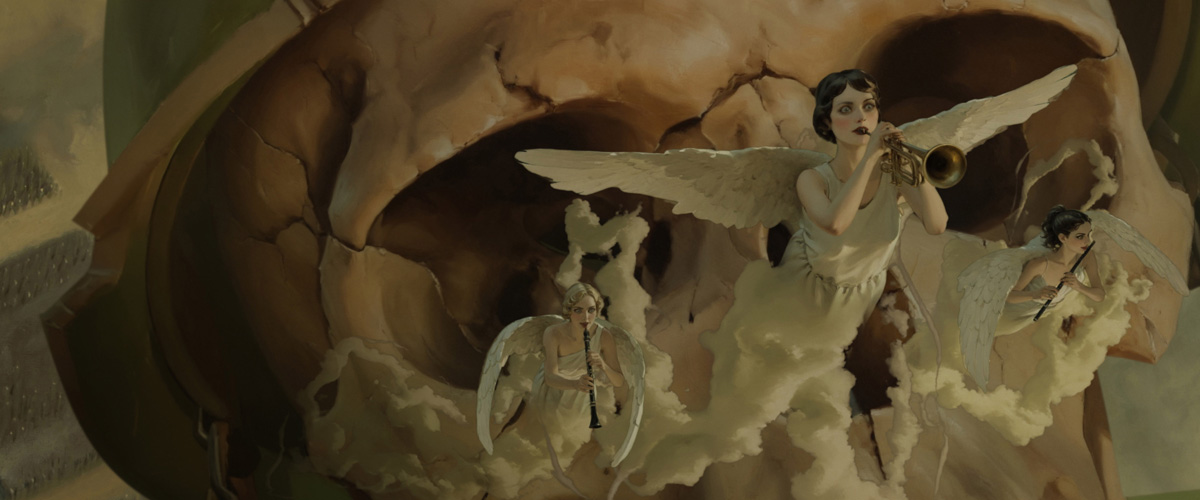
HN: What was like the initial idea of the film, and where did that inspiration come from?
Hisko Hulsing: The inspiration for the film comes directly from the 10th Symphony by Dmitri Shostakovich. I have loved Shostakovich’s music since the age of 14, and the second movement of the 10th symphony evoked strong images in my mind from the first moment I heard it. The music is terrifying—one can hear the panic, the fear, destruction, euphoria, and despair, all condensed into a high-energy 4.5 minutes of mind-blowing music.
Some say that this particular piece of music was meant to be a terrifying portrait of Joseph Stalin, one of the big mass murderers of the twentieth century. The fact is that the symphony was first performed right after Stalin’s death in 1953, so it might be true.
Shostakovich’s whole career developed under the communist regime in Russia, and he had to walk a thin line, always afraid of being banned or imprisoned, even though he was Russia’s greatest and most famous composer. It is easy to hear that in his music. One can hear euphoria, sometimes even real propaganda, but there are always layers of darkness and cynicism, as if Shostakovich wanted to paint a broad picture covering all facets of his life under these hard conditions.
For Danse Macabre, I didn’t work with a script. I was inspired directly by the music. So, I would listen to it every day, seeing what images came up while storyboarding and developing my ideas and the structure of the film—while drawing and daydreaming, not by writing, but by trying to translate the music directly into images and film.
I made quite detailed drawings, because I knew that the drawings themselves would be the inspiration for further ideas. This piece of music doesn’t have a three-act structure; the first climax is right in the middle. So, developing a structure that felt organic while conveying a clear idea was quite hard.
I would say that I ended up with a three-act structure anyway, even though I didn’t plan it that way. I am almost surprised by how organised the film feels now that it is finished.
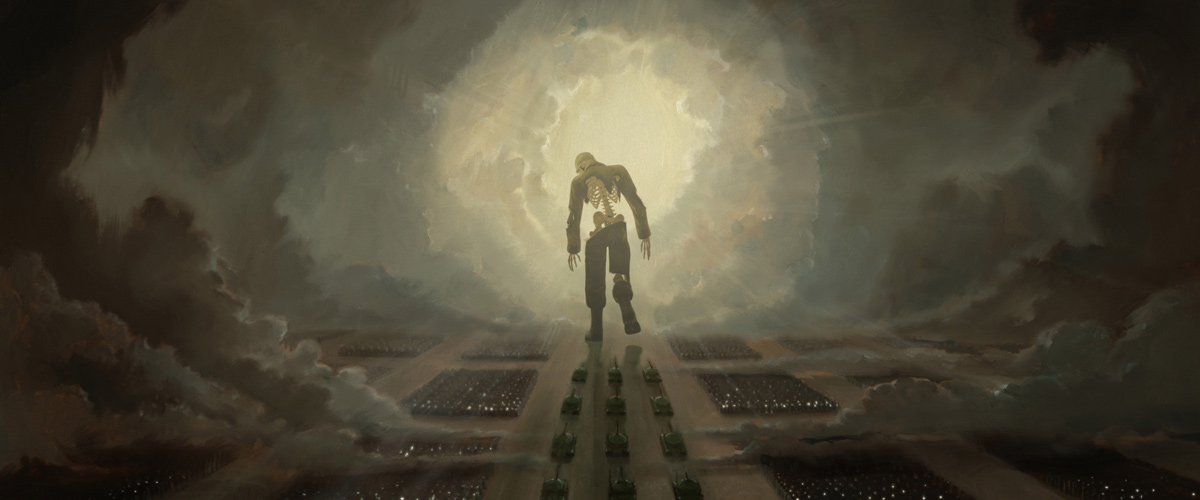
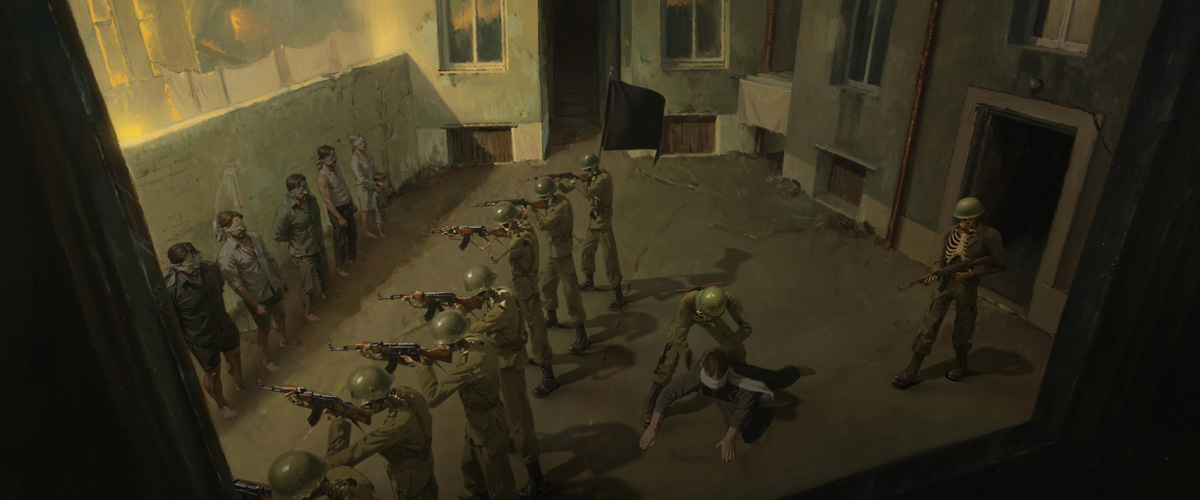
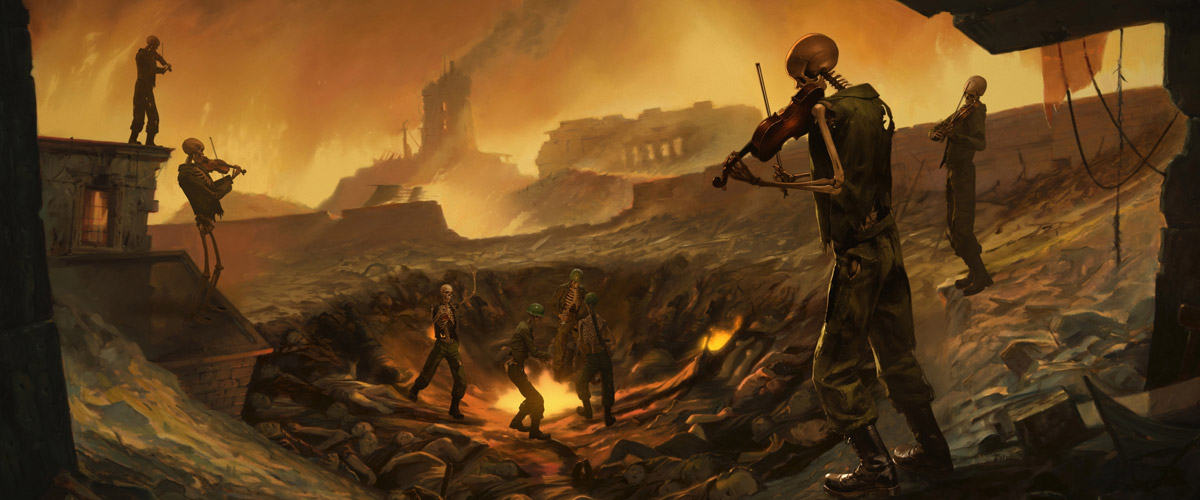
HN: I would like to ask about the visual expression. What were the main sources of inspiration for the film’s visuals, and how did you translate those ideas into concrete visuals?
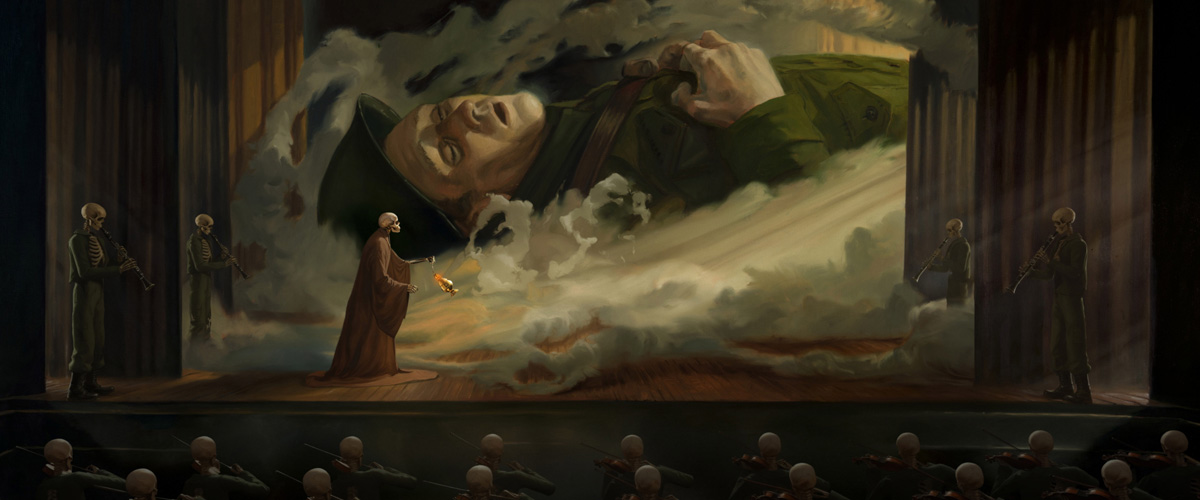
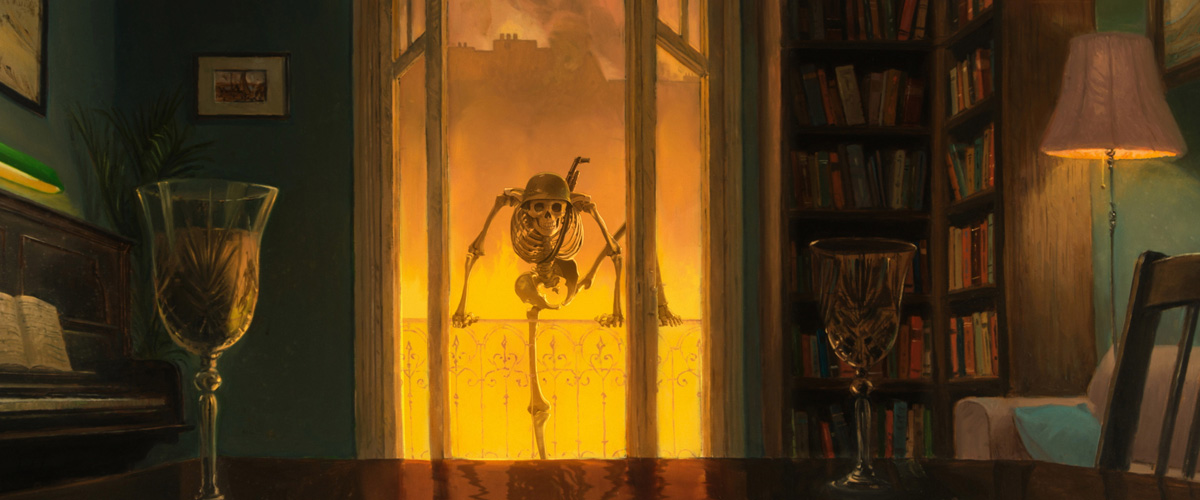
Hisko Hulsing: I started with the storyboards and the animatic. I then made a huge oil painting for every single shot, often with the characters painted into them. My style of painting is very classical, very much inspired by the Baroque painters from Europe—Velázquez, Rembrandt, Caravaggio, and so on. Of course, these painters often created religious pictures, straight from the Old and New Testaments, sometimes even apocalyptic images.
I myself am not a believer—I am an atheist—but I do recognise that apocalyptic thinking is not restricted to Christians or other religious movements. So, the style I developed for my paintings over the years was extremely fitting for the subjects that I wanted to depict in Danse Macabre.
When I started making those paintings, I had no idea how to translate them into animation. I got fed up that I had made so many beautiful paintings for my films, but that they would be seen mainly as backdrops. Usually, the background lacks the main subjects—the characters—so that is why I painted them in this time. I now do have a beautiful series of paintings that accompanies the film.
We did a test in 2017 with projection mapping, and even though that was done pretty well, it still had a game-like look. I had to stop working on the film for about five years, because I got to direct both seasons of Undone for Amazon Prime, with a team of over 200 people, including 10 excellent painters who tried to paint in my style.
When I started working on Danse Macabre again, I figured that it would be a good idea to explore the possibilities of machine learning—to train a model with my paintings to give the 3D animation of the characters a painted look. This was way before anything like AI tools existed. It felt more like working with Windows ’95 when we started with ComfyUI.
But Stein Louise, who helped me with that, eventually found ways to make it work. Every single shot needed a different approach to create the style transfer over the 3D animation that was done in Blender and Houdini by studios in France, Hungary, and the Netherlands.
It turned out beautiful!! When I started out as an animation filmmaker, I was working with cels on 35 mm film, using a huge rostrum camera that I hired somewhere. Since then, I have seen many developments—first with the Amiga computers, Windows 95, Flash, and the revolution of 3D software. And I have always embraced new techniques to come closer to the realization of my vision, which is all based on my paintings.
I think that Danse Macabre is the film that came closest to what I had in mind when conceiving it—closest to my style of painting.
I mentioned the classical influences on my painting style, but of course, like any other artist, I am influenced by thousands of artists working in every possible medium. From a film perspective, that would include live-action directors like Polanski, Kubrick, P. T. Anderson, and hundreds more. I could go on and on about comics, painters, musicians, composers, and animators—the list is endless.
HN: Could you please describe the journey of the film project since the creation of the animatic Resurrection nine years ago, leading to its being greenlit as a large-scale international co-production involving studios from four countries, with particular focus on the challenges, difficulties, key turning points, and factors that contributed to its success?
Hisko Hulsing: This film seemed impossible to make. When I started in 2015, Utrecht-based Il Luster was still producing it. Lovely producers, but when I returned from directing Undone for Amazon Prime and the animated bonus episode for Netflix, they were not so interested anymore, because they realized that the film would be so expensive that it would have to involve multiple co-producing studios within Europe because of the funding system.
Luckily for me, Richard Valk was very enthusiastic about the project. He is full of optimism and never sees ‘bears on the road,’ which is not just a Dutch expression, but also a Dutch attitude at times. Nicolas Schmerkin from Autour de Minuit in France was also texting me each time he saw one of my oil paintings for Danse Macabre on social media: “When will we start working on the film?” He was also really enthusiastic. And Réka Temple from Cinemon Entertainment in Hungary stepped in—same story, super enthusiastic. She ended up putting her own money from Cinemon into the project. And Vivi Film in Belgium was also very enthusiastic. Within a year, all these producers got the money together—470,000 euros in total, mostly from film funds.
That was when we really started the production, which also involved Gao Shan Pictures in La Réunion in Africa. So, four countries for five minutes of film—insane!!
The only thing that nobody was really enthusiastic about was my plan to add the machine learning process at the end of the pipeline—not because they didn’t like how it looked, but because they thought it would be impossible with the techniques available at that time. They had good reason to be worried. But we developed a pipeline in which they would deliver all facets of their 3D animation from Blender and Houdini to us: the cryptomaps, depth maps, canny maps, normal maps, and lit beauty passes, and Stein would feed all that information into ControlNet.
Thirty artists worked on the film—animators, riggers, modelers, and so on—and all that animation was then treated by Stein with a model based on my oil paintings, creating a continuity in style that was never possible before.
Through the years, I have developed several techniques to make the characters feel integrated into my paintings. During Junkyard, I was still a beta tester for TVPaint, and they developed a special tool that made it possible to paint the shadows frame by frame in a somewhat painterly style, which I did all by myself. It took two years of very hard and boring work, but it was worth it—I am still very proud of that film.
We extrapolated that same technique to Undone, which was a huge project, so it had to be simplified a bit. The same goes for The Sandman – A Dream of a Thousand Cats for Netflix. The basis was 3D animation from Untold Studios in London, which then had a frame-by-frame 2D overpainting that we did at the Submarine Studios in Amsterdam. All the oil-painted backgrounds were done by the same team from Undone.
For Danse Macabre, we looked at the shaders available in the 3D programs we worked with, but none of them were close to my painting style. I didn’t want to repeat the style of The Sandman – A Dream of a Thousand Cats, so we started to experiment with ComfyUI, which ultimately led to a whole new style that I am very happy with. The thing is, I don’t like to repeat myself—always trying out new things so that I don’t get bored!
One of the weird things about these multinational productions is that everything is done over Zoom meetings. As always, I made sure that everybody had a lot of reference to work with, so we filmed all shots first with actors and musicians to make sure that the motions and finger positions would be accurate. One of the nice things about starting out with live-action is that I could already edit the whole film on top of the moving storyboard, so I knew that the flow of the film was already established.
We used the free platform Kitsu to communicate. Kitsu allowed the studios to upload their designs and animations, and I could approve them or give notes, which we would discuss further during our production calls.
I have only met a fraction of the 80 people on the credit list in real life—can you imagine…
That being said, I know that all the people involved worked their asses off to make the best animation they could, which shows in the film. I am very happy to have been able to work with so many talented people all over Europe.