
Once Upon an Egg
(Status: in development)
Synopsis
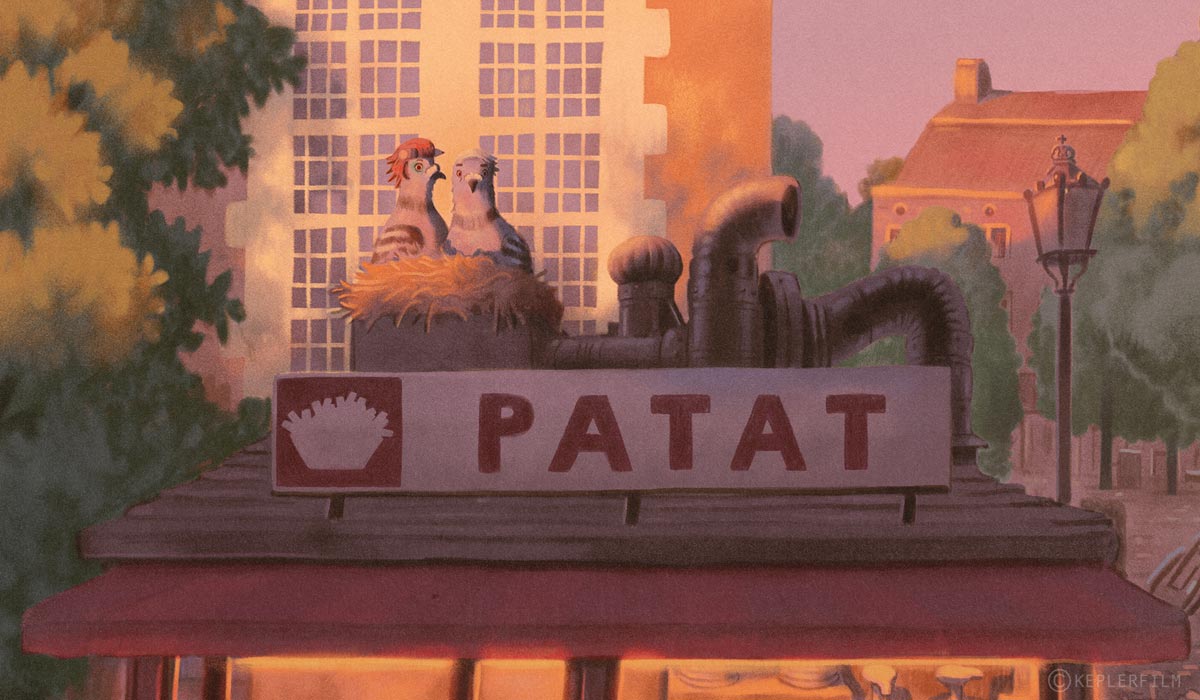
In the stop-motion film Once Upon an Egg, we follow two ordinary grey city pigeons, Molly and Mick, who have struck it lucky with their nest on top of a fry stand in the heart of Amsterdam. One day, everything changes when a cleaning crew washes away their nest — and with it, their only egg. Heartbroken, they set off in search of a new home and a renewed sense of purpose. Along the way, they befriend a young ring-necked parakeet named Brutti and eventually find an abandoned egg. While caring for the egg and for each other, they learn that only by adapting to the changing city can they build a new life — and a family — of their own.
Once Upon an Egg
Director: Nina Gantz
Scriptwriter: Robert Alberdingk Thijm
Main Producers: Koji Nelissen (Keplerfilm, Netherlands) and Derk-Jan Warrink (Keplerfilm, Netherlands)
Co-Producers: Dries Phlypo (A private view, Belgium) and Vladimir Lhoták (Hausboot, Czech Republic)
Character designer: Félicie Haymoz
Music: Terence Dunn
Target audience: Family
Technique: Stop-motion
Running Time: 85′
Once Upon an Egg is a stop-motion feature film project for a family audience that depicts a heartfelt and humorous story centred on pigeons living in Amsterdam.
It is Nina Gantz’s first feature film project, and she is globally famous for the BAFTA and Sundance Film Festival award-winning Edmond (2015), and for her latest film Wander to Wonder (2023), which was nominated for an Academy Award and won a BAFTA.
We heard insightful stories behind this exciting new animated feature film project from Nina.
Interview with Nina Gantz
Hideki Nagaishi (HN): What kind of thing do you want to deliver to the audience the most through this film project?
Nina Gantz: The films and series I watched as a child left a lasting impression on me and even continue to influence my work today. It feels very special to be able to create a film for both children and their parents, and to potentially be part of that same kind of formative, magical experience for another child and perhaps even inspire them in some way.
With Once Upon An Egg, I hope to make a film for the whole family, something warm, full of humour and visually unique. It will have layered storytelling that doesn’t underestimate the kids and can be enjoyed just as much by parents. A true homage to a bird that is often ignored and even dismissed as “flying rats.” We want to show how clever, resourceful and resilient they are, surviving in a hostile and ever-changing city. Perhaps after seeing our film, people will look a little differently at that scrappy bird on the sidewalk.
The film will be completely made in stop-motion, a highly labour-intensive technique that celebrates handcraft and working with real materials.
We also aim to build all the puppets and sets from surplus materials, something I’ve always wanted to try but hadn’t found the right project for before. I love the idea of showing what can be made from what others might call waste, and how it might encourage people to look at everyday materials a little differently and perhaps see their value again.
HN: Where did the initial idea of the story come from?
Nina Gantz: The original idea came from Koji and Derk-Jan, who are the Dutch producers on the film. They saw how the city of Amsterdam was taken over by the green ring-necked parakeets from their window at their office and imagined that the pigeons must not be too happy with them. They thought this could be a great story and contacted me about it just as I graduated from film school about nine years ago.
After I came on board, I asked, the writer, Robert Alberdingk Thijm, to join the team. I am a big fan of his previous works, and he has written many for a younger audience and it felt like we could be a good combination as I had only focused on films for adults until now.
We’ve been working on it for a while now and we have made it a film of our own, but much of the original concept still stands.
HN: Robert joined the film project soon after you joined, right?
Nina Gantz: Yes, but not straight away, as there was another writer attached to the project when Koji and Derk-Jan approached me. After a year or so, she had to leave the project because it conflicted with another project.
HN: What kind of thing are you taking care of the most, or what you feel is really challenging when you are writing the story for the film?
Nina Gantz: I have been directing animation for adults, so it is challenging for me to make something that is attractive for kids and adults at the same time. This balance is important, because I want the film to work on multiple levels. I do not want to rely on a dirty joke that only the parents will understand. I want to create layered characters who are interesting enough for adults to follow, but who also have energy and humour for kids.
It is clearly a challenge, but that’s also why I want to make it. Since I will be working on this for a long time, it is important not to play it too safe. That is usually where the most interesting things happen.
What helps a lot is that it is a musical. The musical form allows us to bring kids in and still be interesting on another level. The songs will not be used only to drive the story, but to set the atmosphere and enhance the characters. The songs need to work on their own, a bit like the classic musicals such as Bambi, Mary Poppins, and West Side Story. We will also try to find fun, distinctive and unique voices for the characters, and use those artists to build a character around them. For example, the voice of King Louie in The Jungle Book, voiced by Louis Prima. That is an amazing reference.
HN: I would like to ask you about some key points of the visual design for the film. Firstly, how and why did Félicie Haymoz, the character designer, join the project?
Nina Gantz: I had already worked with Félicie on a commercial project at Blinkink, an animation production company in London. I admired her work since Fantastic Mr. Fox directed by Wes Anderson, where she also created the designs. She understands animals very well and can bring out a strong character in a subtle way, and because of her experience with stop-motion films, she also understands how we would be able to translate it to a puppet form. She thinks about how the characters move as puppets and how texture can support the storytelling, because it is tactile and physical. It has been an absolute joy to work with her.
HN: Could you please additionally tell us about puppet creation, including the textiles?
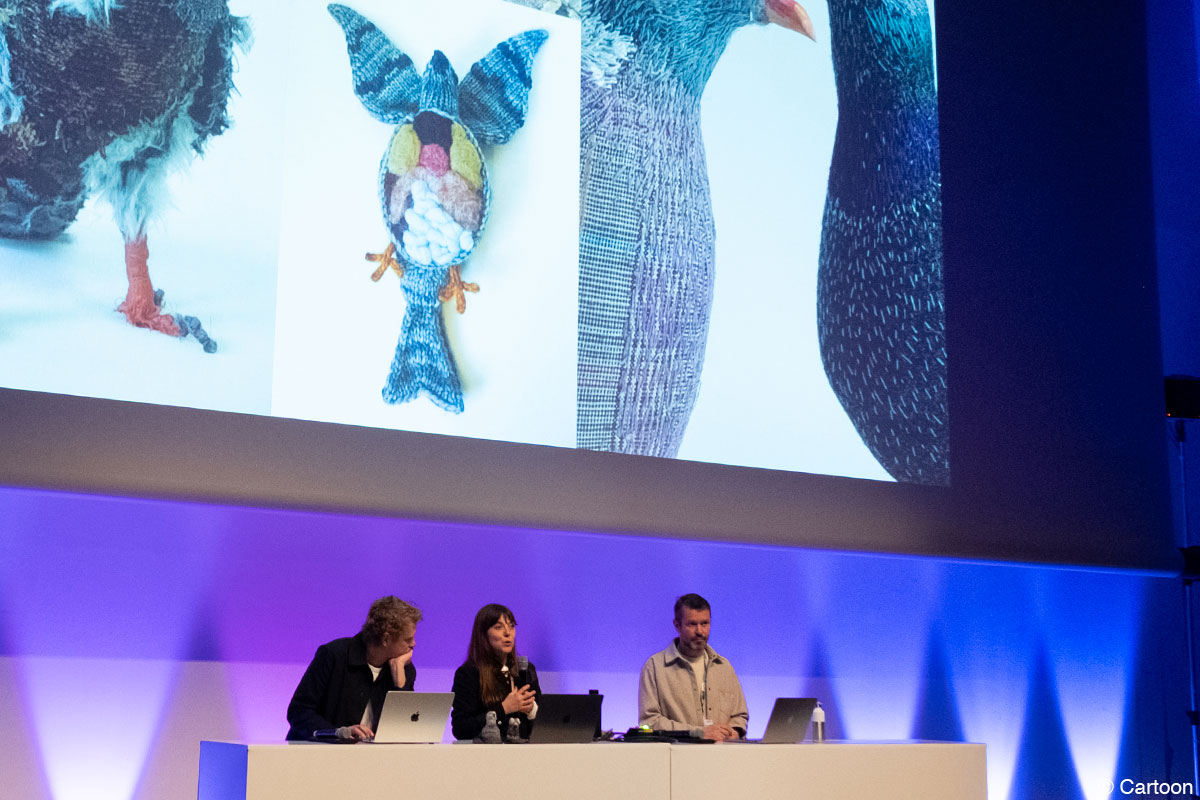
Nina Gantz: The puppets will be made from various textiles such as fabric, wool, and cotton. What I love about textiles is their versatility. It allows us to move away from having to be too realistic and to create something expressive and our own.
You can make a rough looking bird with coarse cotton and wool, or a smooth and beautiful one with, stretchy, shiny, or iridescent textiles. I love how pigeons can look completely haggard one moment, with feathers sticking out at all angles, and then beautiful and sleek the next, almost as if they have shiny fur. It is an effect you can mimic very well with fabric.
This approach also fits the idea of making the film from surplus materials. The clothing industry produces an enormous amount of waste, so we want to use discarded textiles for the puppets. This also matches the film’s theme, since birds make their nests from the trash we leave in the city, and we will use discarded materials to build the puppets.
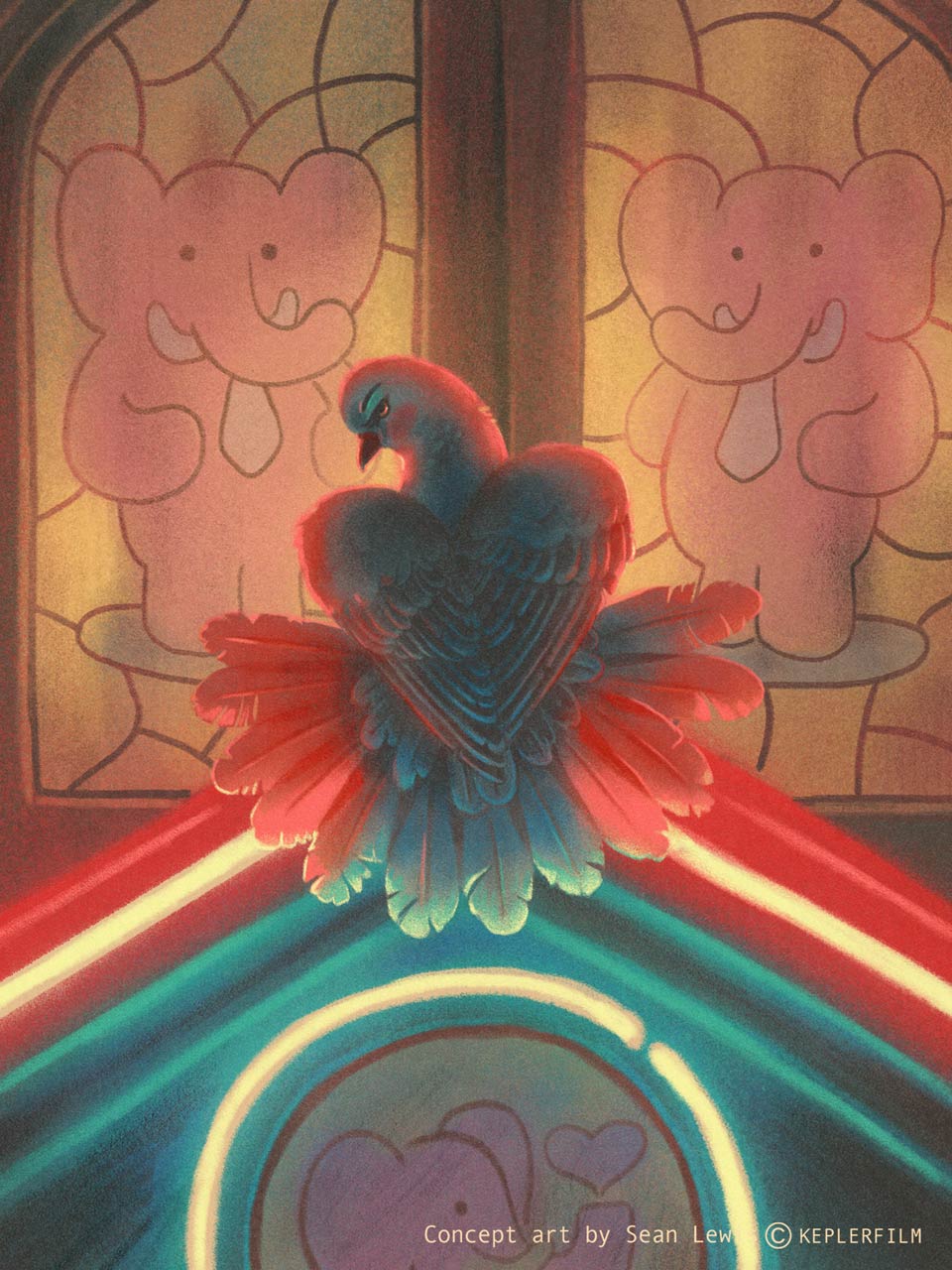
HN: Could you also tell us the story behind how Sean Lewis, who draws the concept art for the film, joined the project?
Nina Gantz: Sean joined the project last year. I had admired his illustration work for a long time. I was looking for someone who could create an atmosphere, and he is very strong with colour and mood. He had also worked on music videos for Sean Pecknold, including the Fleet Foxes videos, which I love. I met him at the South by Southwest festival, and that is how we connected.
HN: The last question is about music. Could you please tell us what you can share so far?
Nina Gantz: The composer is my husband. I have been talking with him about the film and its music for nine years, so he knows exactly what I am aiming for. He composed the music for my previous films as well.
For me, music can make the film go right or wrong, so getting it right is essential. We will use both large orchestras and very small ensembles, or even solo artists, so the soundtrack will have a wide variety. We plan to record it in a special way, similar to old musicals, with everyone recording together on one microphone. The film is handcrafted, and the music will also be made in a very traditional way.